
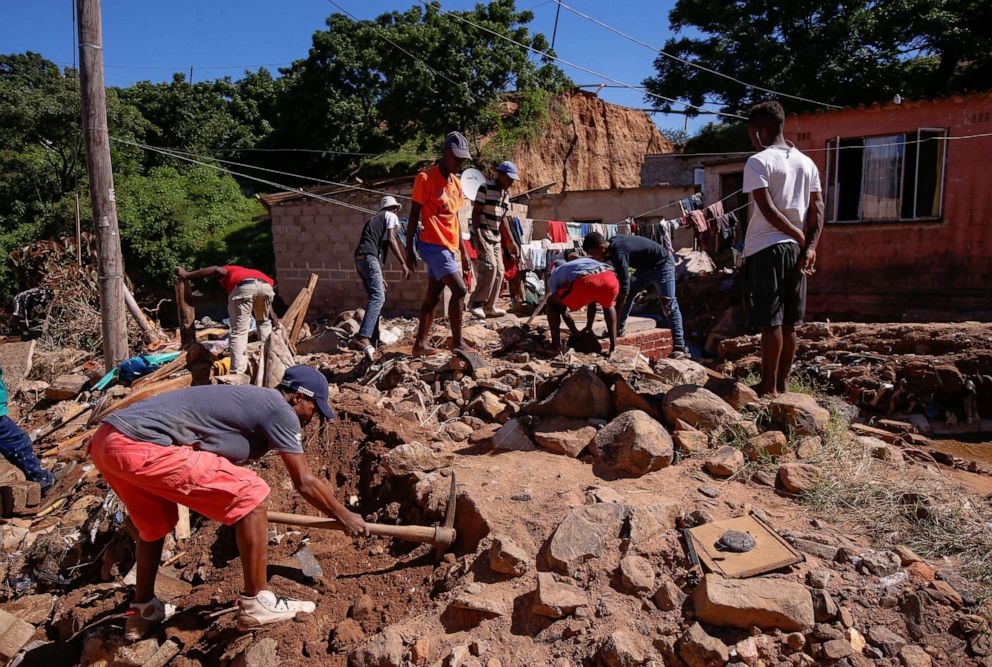

The South African Cabinet has declared a national state of disaster to respond to widespread flooding that have swept the provinces of Kwa-Zulu Natal and the Eastern Cape. As many residents of the two provinces take stock to recover from the devastating floods that have washed away not only their valuables like houses and vehicles, but also the lands and roads beneath their feet, many are wondering where will they really start to fix the damage and get their lives back to normal. The government has announced that at least over 448 lives have been lost and as much as 48 people were missing. These statistics are expected to rise.
On the other side of the country in the Western Cape, in the township of Langa in Cape Town, over 300 homes were gutted by an inferno that left over 1000 people displaced. Relief efforts are stretched to the limit on their quest to help residents of the three provinces to recover and rebuild their lives following the respective disasters.
“We are a nation united in our determination to assist those who have lost their homes and possessions, and who are in desperate need of food, water and shelter”, said President Cyril Ramaphosa addressing the nation on Monday 18th April 2022. In a sense, it is estimated that close to 4000 homes have been totally destroyed and more than 8300 have been partly blemished. The floods alone have rendered 40000 people homeless. Ramaphosa has termed this a “humanitarian disaster that calls for a massive and urgent relief effort”.
The Premier of Kwa-Zulu Natal is on record saying the damage would “run into billons of rand”. eThekwini Metropolitan Municipality Mayor Mxolisi Kaunda has estimated the cost of flood damage to be R757 million. As a start, the South African government has set aside R1 billion to launch a three-phase response to this disaster by offering immediate humanitarian relief, re-housing people who have lost their homes, and lastly reconstructing and rebuilding damaged houses.
Human influence on climate
We live in a period in which human activity is influencing climatic and environmental conditions on earth, meaning what we experience today can be directly linked to human behaviour. Many parts of South Africa have been hit by flood disasters before and the intensity of the damage and impact on various communities varied significantly. Each time floods swept the land, lives were lost, livelihoods destabilised and infrastructure damaged. Recovery from those disasters came at a huge cost whereas in some instances, people have not been able to get things back to the way they were.
A 2019 study titled “Rediscovering South Africa: Flood disaster risk management through ecosystem-based adaptation” conducted by Busayo and colleagues suggests that Ecosystem-based Adaptation (EbA) can be a comprehensive and cost-efficient solution to prevent possible flood disaster risk management.
The South African National Biodiversity Institute (SANBI) describes Ecosystem-based Adaptation as “the use of biodiversity and ecosystem services to support communities to adapt to life in a less predictable climate system”. To achieve this adaptation, communities need to invest in the “management, restoration and rehabilitation of ecosystems”. In return, their services become an investment in localities that depend on them. SANBI believes that an EbA attempt can reduce flooding, improve water and soil quality, and contribute to livelihood opportunities.
Flood damage can be moderated through property “insurance and EbA” on settlements as well as putting into place “reliable floodplain management requirements” and property owners’ taking out flood insurance cover on their properties. Through property insurance, people can be protected from flood disasters of this nature. The purpose of property insurance during flood disasters is to offer alternative support to reduce the rocketing costs of restoring the damaged property. The South African law does not require a person to have property insurance. However, banks would only issue a property loan in the event that insurance is taken out on the said property.
What is known from historical facts is that only a handful of damages accounted for would be insured. For instance, flood disasters of 1987, as observed by Busayo and colleagues were insured to the value of $248 000 and the 2016 ones for about $146 000. But how many households and business premises were insured?
The big task now is for municipalities to put in place EbA solutions as part of reconstruction of affected communities. Insurers on the other hand need to revise property insurance strategies to attract and retain more clients, especially those whom their properties are not financed or paid-off and those in less privileged areas like townships and rural areas.
This article was first published in The Sowetan Newspaper (https://www.sowetanlive.co.za/opinion/columnists/2022-04-21-ecosystem-based-adaptation-can-help-with-flood-damage/?fbclid=IwAR2CKKnGnZ4PsZRYQr0-xEPFCmVA7BjaRFvS5EhxS9VwOYz2BK_DIbKnQjI).